
When a Tiny Layer of Buildup Starts Changing the Way Your Mini Split Works
A mini split can quietly lose performance long before it stops cooling or heating a room. For homeowners searching for mini split cleaning in Vancouver WA, one important area to examine is the evaporator coil assembly, where dust, moisture and organic residue can gradually interfere with airflow and create conditions that support unwanted biological buildup.
A professional mini split cleaning evaluates the indoor head unit, evaporator coil fins, blower wheels, drain pans and airflow pathways for signs of accumulated debris or moisture-related buildup. By identifying restricted airflow and cleaning appropriate components, technicians can help restore system performance while recognizing conditions that may require maintenance or repair.
The challenge is that this buildup often develops gradually, so there may not be an obvious warning at first. A homeowner might notice that the indoor head unit isn’t moving air as strongly, the room takes longer to reach the desired temperature, or a faint musty odor appears after the system starts. These changes can make a closer look at the evaporator coil and drainage pathway worthwhile, especially when routine filter cleaning hasn’t restored normal performance.
What Does Mini Split Cleaning in Vancouver WA Look Like Inside the Coil Assembly?
Mini split cleaning in Vancouver WA involves more than wiping the outside cover or washing an air filter. A thorough cleaning can examine the condition of the evaporator coil fins, blower wheel, drain pan and surrounding airflow passages. These components work together, so buildup in one area can affect what happens in another.
For example, a dirty evaporator coil can restrict airflow across the heat-exchange surface. A blower wheel coated with debris may also struggle to move air efficiently. The result can be weaker airflow, uneven room temperatures or longer operating cycles. In a heating and cooling system that operates through multiple seasons, these small losses can become increasingly noticeable.
The drain pan deserves attention as well. If water doesn’t drain properly from the pan, moisture can remain around the indoor head unit and create conditions that encourage biological growth. Signs of a drainage problem may include standing water, staining, unpleasant odors or recurring moisture near the unit. Better Air Northwest can assess these conditions during mini-split cleaning services and help customers distinguish cleaning needs from refrigerant issues or equipment faults.
Why Can a Mini Split Develop Buildup Where You Can’t Easily See It?
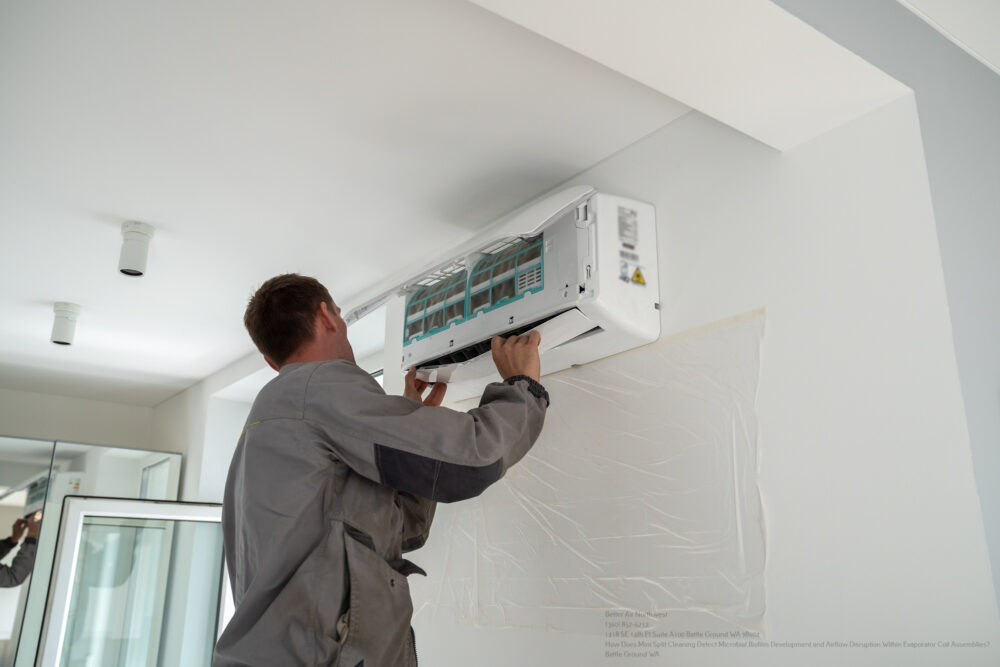
Ductless mini-splits have a compact design that houses several important components inside the indoor head unit. During normal operation, air passes through filters and across the evaporator coil before being moved back into the room by the blower wheel. Dust that bypasses the filters can gradually accumulate on these surfaces, particularly when the equipment operates frequently.
Moisture adds another layer to the problem. Air conditioning naturally removes moisture as the evaporator coil cools incoming air, allowing condensation to collect in the drain pan before leaving through the drain system. When moisture, dust and organic particles remain together, a thin film can develop on surfaces. This is sometimes described as microbial biofilm, although visible residue should not automatically be assumed to be mold or another specific biological contaminant.
The U.S. Environmental Protection Agency emphasizes that moisture control is central to preventing mold growth and recommends keeping HVAC components, drain pans and related systems properly maintained. Its indoor air quality guidance also points to filtration, ventilation and moisture management as important parts of maintaining a healthier indoor environment.
Need Mini Split Cleaning for Your Property?
Contact Better Air Northwest today for professional, dependable service.
How Does Cleaning Help Protect Airflow and Energy Efficiency?
Clean airflow isn’t just about comfort. When air flows properly across the evaporator coil and through the blower assembly, the system is better able to transfer heat as designed. When those pathways become restricted, the equipment may need to operate longer to achieve the same result, which can influence energy use and the energy bill.
This is particularly relevant for ductless mini-splits because homeowners often choose them for zone control and efficient heating and cooling. ENERGY STAR notes that ductless heat pumps can provide efficient heating and cooling when properly operated and maintained, and recommends clean filters as part of good equipment care.
Consider a simple example. A single indoor unit serving a bedroom may gradually develop dust accumulation around its coil and blower wheel. The homeowner might first notice weaker airflow, then longer cooling cycles. Cleaning the affected components may address the restriction, while a system inspection can determine whether another issue is present.
For customers seeking mini split cleaning in Vancouver WA, Better Air Northwest can focus on the condition of the equipment rather than assuming every performance complaint has the same cause. That approach can help protect comfort while supporting sensible HVAC maintenance.
What Can Homeowners Learn from Changes in System Performance?
One of the most useful lessons is that gradual performance changes deserve attention before they become major failures. A mini-split that still operates but produces weaker airflow, inconsistent temperatures or unusual odors may be indicating that something inside the system has changed.
The goal isn’t to assume that every odor means microbial contamination or that every dirty coil indicates a serious air quality problem. Visual residue can have several causes, and identifying mold or other biological contaminants may require specialized expertise.
A local HVAC contractor can also distinguish cleaning concerns from mechanical problems. Refrigerant levels, electrical connections, blower operation, outdoor condenser performance and other components can influence the heating and cooling system. If cleaning doesn’t resolve the symptoms, a deeper system inspection or ductless mini split repair may be appropriate.
For Vancouver, WA homeowners, the practical takeaway is straightforward: watch the system, pay attention to airflow and moisture, and address changes before they become disruptive. Mini split cleaning in Vancouver WA can be an important part of that preventive approach when dust, residue or moisture-related buildup begins affecting the indoor assembly.
Why Better Air Northwest is a Smart Choice for Mini Split Care
We at Better Air Northwest provide the best solutions for our customers by approaching mini-split cleaning as more than a surface-level task. Our service focuses on the areas that directly influence airflow, including the indoor head unit, evaporator coil, blower wheel and drain pan, while recognizing when a separate repair or HVAC evaluation may be necessary.
We showcase excellent service through careful cleaning practices and a customer-focused approach that keeps equipment condition at the center of our work. We also help customers understand why buildup develops and which routine maintenance steps can support a longer system lifespan and dependable performance.
If your ductless system has developed weaker airflow, unusual odors, moisture concerns or declining heating and cooling performance, contact Better Air Northwest for professional mini split cleaning in Vancouver, WA. Give the equipment a proper evaluation before a small buildup problem becomes a larger comfort issue. For dependable mini split cleaning in Vancouver WA, Better Air Northwest can help restore cleaner airflow and support more consistent ductless system performance.
Need Mini Split Cleaning for Your Property?
Contact Better Air Northwest today for professional, dependable service.